


Marina Lencina after completing the Torres del Paine: “What I’m most proud of is that a Chilean woman achieved this in her own country”
16/09/2026
16/09/2026
 8 min
8 min


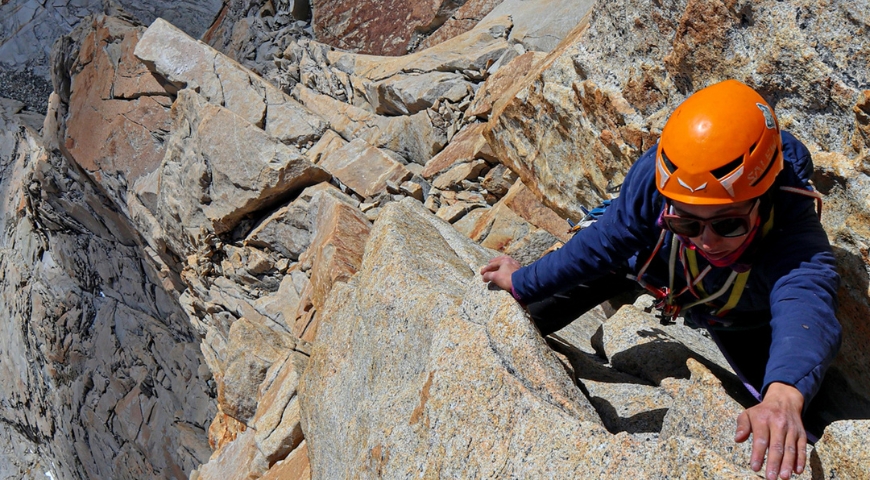
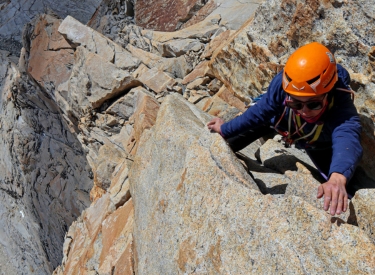
Marina Lencina, our Chile Nativo guide has become the first Chilean woman to complete the ascent of the three Torres del Paine — Norte, Central and Sur — as well as Cerro Peineta, a formation that is commonly considered a fourth tower within the mountaineering community. Behind this achievement are four years of preparation, failed attempts, difficult decisions and a deep connection with the mountains.
For Marina Lencina, Torres del Paine was not always so close. A psychologist by profession, she began her journey into climbing by teaching at climbing gyms and later became certified as a rock climbing guide. It was then that she began looking toward Patagonia.
She had tried to visit Torres del Paine National Park during the pandemic, but the trip had to be cancelled. Finally, during the 2022–2023 summer season, she made it there for the first time. Her first destination was Valle Bader, where she climbed Cuerno Este and discovered a place that would eventually transform her life.
“I fell in love with it. I loved it and thought, ‘How can I stay here?’” she recalls.
What was originally meant to be a two-week stay ended up extending through the entire summer. Marina began working as a guide and found in Torres del Paine a place where she could combine her profession with one of her greatest passions: climbing.
Today, she is part of the Chile Nativo team, guiding trekking, mountaineering and climbing experiences in one of the places that has had the greatest impact on her journey. At the time, however, the Towers still seemed like a distant dream.
Four years to complete the challenge
From the moment she began imagining herself climbing the great walls of Paine to completing this challenge, Marina spent around four years preparing.

Within the mountaineering community, it is common to refer to the “four Torres del Paine” to include La Peineta alongside the three main Towers: Sur, Central and Norte. The term comes from common usage among mountaineers, as the formation known as La Peineta can appear as a fourth tower depending on the perspective from which the massif is viewed.
To complete this challenge, Marina had to combine training, experience and careful planning. Over approximately four years, she trained through indoor and outdoor climbing, physical conditioning and gym work, while the conditions on the Towers meant carefully making the most of weather windows.
“You can’t climb the Towers that much because of the weather. It’s very windy and it becomes dangerous,” she explains.
Her journey began with Torre Norte, which she climbed in February 2024 via two different routes. At the end of January 2026, it was time for La Peineta, followed by Torre Sur and Torre Central, both climbed in February.
Choosing this period was not a coincidence. February generally offers more favorable temperatures and less snow and ice on the walls, although, as Marina points out, there are never any guarantees in the mountains — and climbing has taught her that well.
When the mountain challenges you
Climbing Torre Sur was, for Marina, one of the most demanding moments of the entire process. During the descent, a storm reached the climbing team and conditions changed rapidly. The wall, ropes and even their jackets began to freeze.
“Torre Sur was really important because I experienced all the nightmares you have as a climber: having a storm on the wall, your ropes getting stuck, everything freezing — all of that terrifying stuff,” she says, laughing. The experience also showed her the importance of something she considers fundamental in the mountains: being prepared and trusting your team.
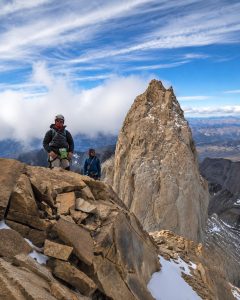
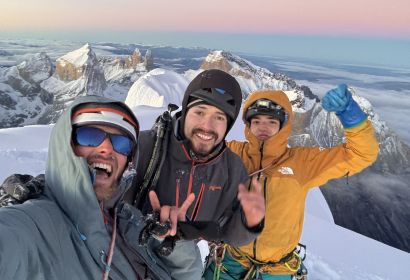
“Without Cristóbal and Franco, it would have been impossible, because we all kept a good attitude. We worked together and supported each other to free the rope and rappel down,” she recalls.
The situation ultimately became one of her greatest lessons: even in difficult circumstances, having the right equipment, a strong climbing team and the ability to remain calm can make all the difference.
Trying again
If there was one Tower that was especially meaningful to Marina, it was Torre Central. She had already attempted it twice. The first time was in 2024, when they chose the first day of their weather window and found the wall still frozen after a storm.
The second attempt took place this year. Conditions were favorable, but another climbing team had started ahead of them, and waiting behind them would have meant spending too much time exposed to the cold and strong winds. The decision was to turn back, change objectives and head toward La Peineta.
“Those were the two attempts,” she says. “And the next time we went, we got there first. Torre Central is a goal that all climbers want to climb. There were more teams, but we got there first and the weather window was much better: less wind and better temperatures. It was much more enjoyable.”
This time, together with Franco Rojas, she finally reached the summit. “Central was the most important one because I had tried it twice before I was able to make it. It was the most intense and the most enjoyable because when we finally did it, it was incredible — a dream I had been waiting for for a long time.”
With this ascent, Marina completed all four: Norte, Peineta, Sur and Central.
Beyond the achievement
Completing the Torres del Paine is an extraordinary athletic achievement, but Marina does not see the mountains as something that simply needs to be “conquered.” One of the most important lessons she has learned over the years is knowing when to move forward and when to change plans.
In the mountains, she explains, you always need alternatives. A route may not be in condition, a weather window may close or conditions may change. In those situations, having a Plan B — or even a Plan C — can make the difference between a safe outing and a risky situation.
“It’s a huge effort to go all the way there and not be able to climb what you wanted, but you can still climb and train so you can do it later. You always have to include that in your planning.” For the same reason, learning to manage your emotions is also essential.
For Marina, a good climbing team is not made up solely of people with strong technical skills. It also requires people who can face stressful situations together:
“A good team is made up of people who can control their emotions so they don’t lose their temper. You can feel anxious, of course, that’s normal, but you express it properly, and instead of focusing on the problem, you focus on finding a solution.”
Opening more space for women
Her achievement also has a historical dimension: Marina became the first Chilean woman to complete the four Torres del Paine. Marina tries to approach climbing as an activity independent of gender. At the same time, she recognizes that women remain a minority in these spaces and that mountaineering has historically been shaped by a strong male presence.

Throughout her journey, she has also faced comments questioning her abilities because she is a woman. Her response has been to trust her own skills and find things out for herself in the mountains.
That is why, rather than focusing solely on the title of being the “first woman,” Marina values the possibility that her experience can open new doors. “More than being the first woman, I like the fact that I feel it opens doors and inspires more women to achieve these things.”
But there is something that means even more to her: “What I’m most proud of, beyond being the first woman, is that a Chilean woman achieved this in Chile. Most of the first ascents of almost all the Towers in Paine were made by foreigners.”
For Marina, encouraging more women to take part in climbing is not about eliminating fear. It is about learning to live with it.
“It’s not that you climb without fear; you climb with fear many times,” she says. “You have to try to make sure fear doesn’t paralyze you, but instead helps you stay alert.”
Listening to Paine
After so many years connected to the territory, Torres del Paine continues to teach Marina something that cannot be learned in a gym or on a climbing wall: patience. “The Towers teach me a lot about patience. They have taught me, and continue to teach me, that I don’t control everything. It’s a very wild environment.”
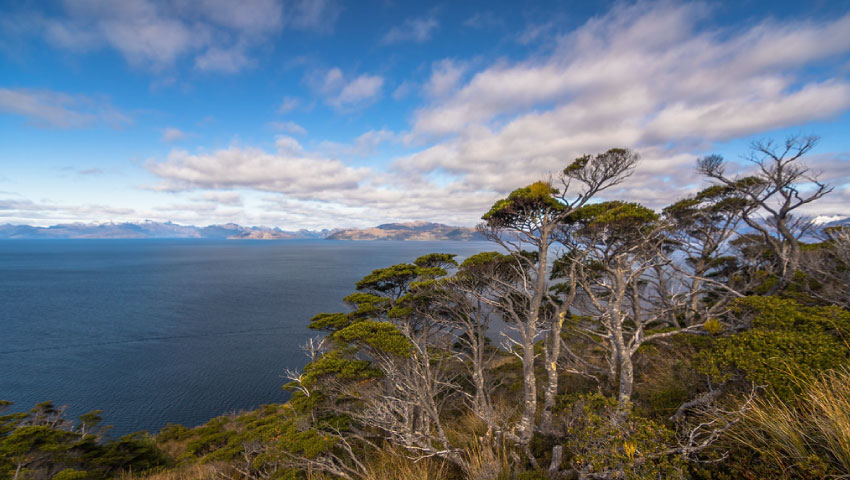
For her, being in the mountains means observing. The sky, wind, lake, sounds and traces of wildlife can all provide information that is essential when making decisions.
“The mountain doesn’t move. Paine is there; if you know how to read it and listen to its signals, you’ll be able to enter the mountains.”
Marina arrived in Torres del Paine intending to stay for just a couple of weeks. She ended up making it her home and workplace, as well as the place where, four years later, she completed a challenge that once seemed far beyond reach.