






Puma Tracking in Torres del Paine: Following the Footsteps of Patagonia’s Great Feline
16/03/2026
16/03/2026
 8 min
8 min


A day of searching, patience, and reading the landscape in one of the places with the highest concentration of pumas in South America. This was our team’s Puma Tracking in Torres del Paine experience, following the clues of this enigmatic feline.
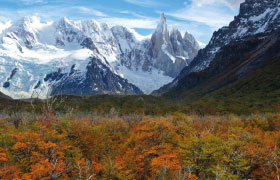
Rarely had the Park revealed itself so clearly. Not a single cloud covered the mountains on the horizon we were heading toward. A privilege that only increased the excitement as we approached the starting point of the day’s adventure: Puma Tracking. A promising sign for what we hoped would be a successful day.
This activity takes you to Torres del Paine National Park with a clear objective: to track and observe the largest feline in South America.
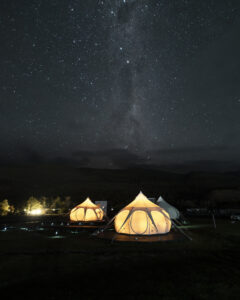
If you are thinking about joining a Puma Tracking experience with Chile Nativo, there are two ways to live it. The first is to book the full program, which includes two days of searching and accommodation at our Riverside Camp, significantly increasing the chances of an encounter. The second option is to add one or more Puma Tracking days as an extension to another program, allowing you to complement your itinerary with time dedicated exclusively to searching for pumas.
Depending on the group size and the travelers’ needs or interests, the activity can take place in a van, where the group shares the journey, exchanges information, and experiences the search together, or directly in the tracker’s vehicle, which allows for a more focused tracking and observation dynamic.
Our Puma Tracking Experience
On this occasion, we departed from Puerto Natales at 6:00 AM toward Torres del Paine National Park.
Still in the dark, our guide Miguel introduced us to the logic behind the activity: what to pay attention to, how to behave, and which signals in the landscape we should learn to interpret.
Years of experience have made him an expert tracker, with a long trajectory not only in Patagonia, but also in different parts of the world. During the drive he explained something essential: in nature, everything communicates.
From bird calls, footprints in the ground, and the flight of condors, to the behavior of guanaco, every sign can reveal something.
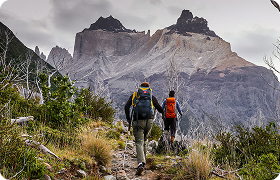
The conversation kept us attentive during the two-hour journey. As dawn began to break, we arrived at the park. A clear sky painted the mountains in shades of blue, yellow, and violet, revealing a landscape as vast as it was silent. The Patagonian steppe framed the long roads, transmitting a sense of freedom and disconnection that only Patagonia can offer.
Sightings of puma in Torres del Paine are generally more frequent than in many other parts of the world. The concentration of these felines in the park is among the highest in South America and, together with the abundance of guanacos (its main prey) and strong wildlife protection policies, has allowed the population to remain stable.
For this reason, when entering the park, the first rule is simple: slow down and respect the environment.
Foxes, guanacos, armadillos, and even pumas may cross the road at any time, and it is our responsibility to protect them.
Entering the park also changes the dynamic inside the vehicle. We drive more slowly and remain attentive to every signal in the landscape. Guides communicate constantly by radio, sharing information that might help locate a puma.
In that sense, the search is also a collaborative effort among trackers: exchanging information, reading the landscape, stopping, and observing. This process can take hours, even days, which makes patience an essential part of the experience.
In search of a Puma
We began the search near the Laguna Amarga sector, the last place where a puma had been seen the day before.
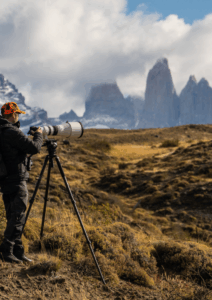
There, Miguel also explained some technical aspects of using binoculars and taking photographs. This program has a strong photographic focus: lenses, batteries, adapters, and various accessories are available to help capture the moment of a sighting. From there we began our first scan of the surroundings, paying close attention to the behavior of the guanacos.
Nothing.
For almost an hour we moved forward without clear signs: the guanacos were calm, there were no condors flying overhead, and the landscape remained quiet.
After exchanging information with other trackers, the first clue arrived: a group of pumas had been seen feeding in the nearby hills. That meant that, after eating, they would likely descend in search of water or begin to disperse.
We continued the search with renewed hope.
But for another hour, nothing appeared. Everyone seemed to have lost the trail, and all that was left was to wait. Then came the second alert: a female had been seen descending the hill alone, apparently separated from the group. We identified the direction and headed toward the area with growing anticipation.
But excitement could not make us rush. In tracking, patience remains key.
We reached the indicated point… and nothing.
 We continued along the road until we decided to turn back and return to the place where we believed she might appear. And then it happened.
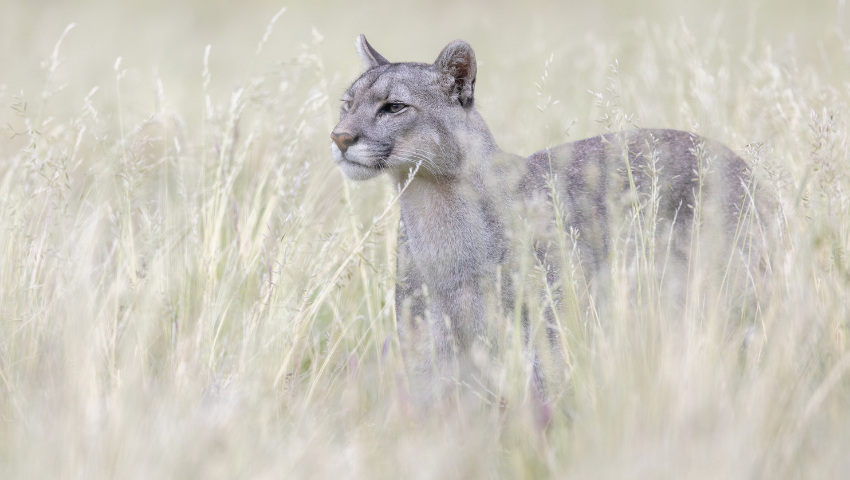
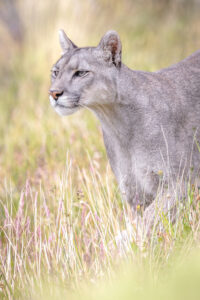
In perfect synchrony, we saw a female puma slowly descending the hillside.
The emotion is difficult to describe. Even if you have seen one before, its presence is hypnotic. Elegant, silent, completely at home in the landscape.
We were able to observe her from the vehicle and, with great care and distance, step out to take a few photographs while always remaining beside the car. It was a well-known female named Escarcha (Frost), named for her grayish coat.
She walked slowly while we all remained silent. The sighting lasted only a few minutes, but it felt much longer.
Eventually, Escarcha lay down among the grasses to rest. We decided to wait at a distance for when she might move again. Meanwhile, mate, coffee, shared snacks, and long conversations accompanied the hours by the roadside.
Escarcha kept sleeping.
A couple of hours later, we headed back, happy.
Puma Observation Protocols in Torres del Paine
Since 2025, the puma observation protocol in Torres del Paine National Park has been updated, incorporating new guidelines to ensure responsible and safe encounters for both visitors and wildlife.
These measures aim to minimize human impact on pumas and their environment, allowing wildlife observation to take place in an ethical and sustainable way. Among the most important principles are maintaining a safe distance during sightings, avoiding blocking the animal’s natural movement routes, minimizing noise, and limiting observation time if the puma’s behavior begins to change.
The protocol also reinforces the importance of never chasing or surrounding the animal and always maintaining control of the group. Guides and trackers play a key role in this process, as they interpret the puma’s behavior and determine when it is appropriate to observe, approach, or move away.
Another fundamental aspect is coordination between guides and trackers within the park. The exchange of information helps prevent excessive concentrations of vehicles in a single area and allows sightings to occur in an organized and respectful way.
The Puma Tracking experience with Chile Nativo follows these protocols and best practices, promoting conscious wildlife observation.
More than searching for the perfect photograph, the goal is to understand the behavior of the puma and appreciate its role within the Patagonian ecosystem.
Because, in the end we can only protect what we truly know.